Why does Concept Explication Matter in Research?

Keywords: Concept Explication, Conceptual Definition, Research
Introduction
Concept explication is an extremely important part of research. To understand how to explicate a concept’s definition, we must first understand what concepts are and how they are useful to research.
Concepts are representations of phenomena. As Wacker (2004) put it, “a formal conceptual definition is a clear, concise verbalization of an abstract concept used for empirical testing” (“A.2.1. The Conceptual Foundation: definitions of terms used for conceptual definitions” section, para. 7). For example, take the word “justice.” We have all heard the word before and have some pre-existing idea about what it means. However, it is not describing something that we can physically see with our eyes. This is an abstract concept. The word “justice” is the label that describes our pre-existing knowledge on the concept behind the word. The words by themselves are not the concepts, rather they are labels that represent the concepts. Concepts are very useful for research, because they help researchers identify and organize what they want to study. Therefore, to use “justice” as a concept, a researcher must first define what it means in order to see what exactly it is they are studying. Miller (2023) emphasizes that weak definitions can lead to many problems in the research later on.
Importance of Explication
Sundar et al. (2024) define explication as “an exercise that encourages us to get to the ‘core’ meaning of a concept by defining carefully, with precision, and clarity” (p. 13). Thus, researchers looking to undergo the explication of a concept should look to find the “core meaning” or crux of that concept. Explication can be seen as a bridge between the conceptual realm and empirical realm (Sundar et al., 2024). In explaining this analogy, Sundar et al. (2024) go on to say, “I like to think of explication as a ‘validity-bridge-building’ activity, where a researcher travels back and forth between defining a concept and devising ways to measure it in such a way that they retain the core meaning of the concept” (p. 14).
When looking at concept definitions, it’s important to know the difference between common or ordinary concept definitions and scientific concept definitions intended to be used in research. Hupcey and Penrod (2005) define ordinary concepts as concepts people use in everyday life. These ordinary concepts have meaning, of course, but a person’s personal definition of that concept may vary significantly to someone else’s personal definition of that same concept. The same is true in research. Just because one researcher defines a concept one way, doesn’t necessarily mean that other researchers have defined that same concept in the same way. Without scientific conceptual definitions, the researcher’s use of the concept may be defined by their own personal interpretation of the concept. This poses a problem for later readers or researchers, because they may interpret that concept differently from the original researcher. This problem can lead to significant challenges and issues later on in the research, specifically when it comes to measurement of those concepts. This illustrates why careful, concise, and clearly worded scientific conceptual definitions are important and useful in research.
Miller’s Seven Steps
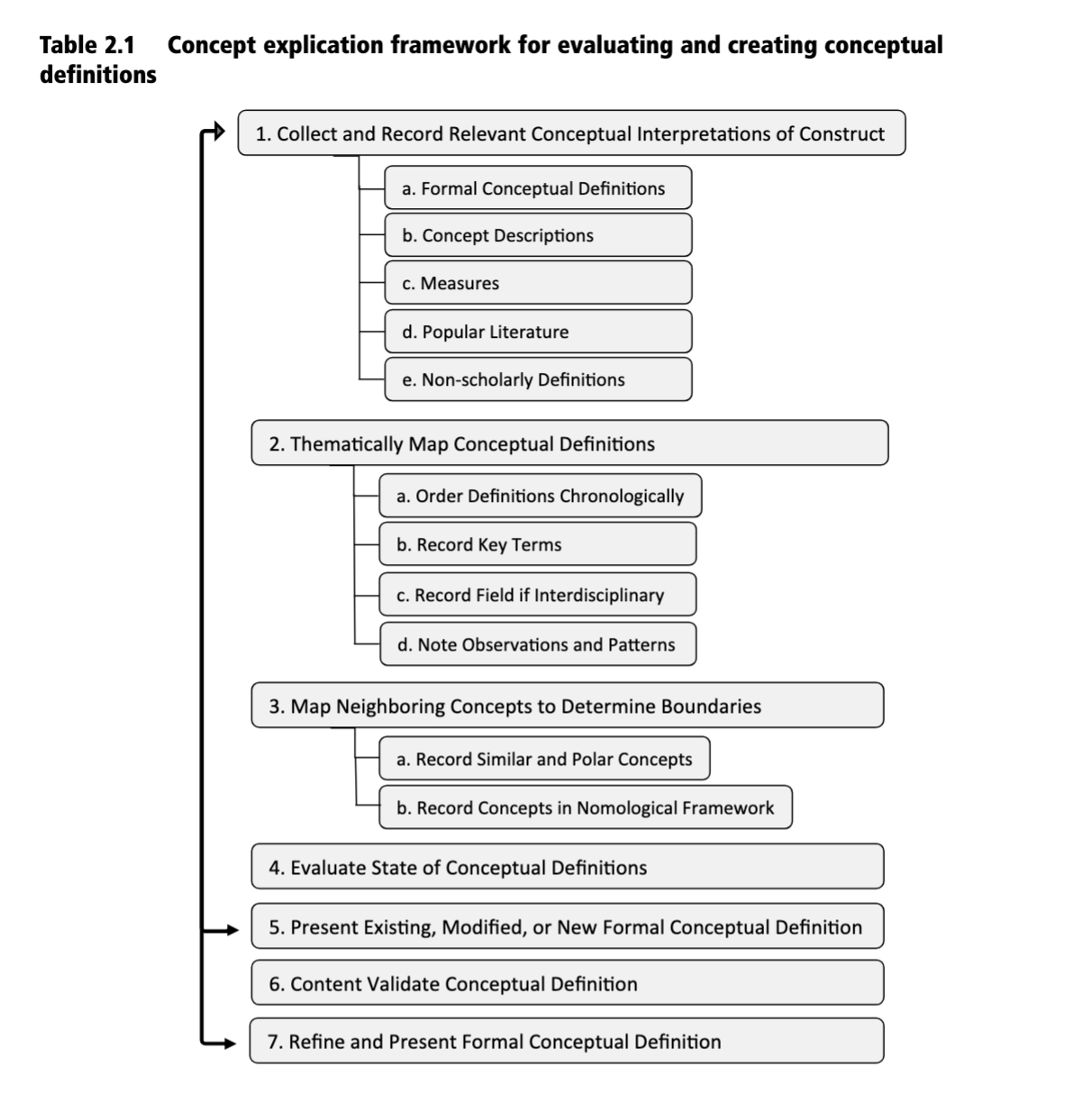
Miller (2023) presents their “Concept explication framework for evaluating and creating conceptual definitions.” This framework is a seven-step process for sorting through and creating conceptual definitions. According to the framework, researchers should start by collecting and recording existing interpretations. This means to find existing interpretations and definitions of that concept that are relevant to the research being conducted. The next step in the framework is to map those definitions that the researcher collected. In mapping the definitions, the researcher should put them in chronological order, record their key terms, identify patterns in them, and note observations. Step three then takes in “neighboring concepts.” This means to find and record similar and opposite concepts and concepts within the nomological framework in order to find boundaries in the definitions. Step four is to then evaluate those definitions. In evaluation, researchers are looking for ambiguity, vagueness, and circular definitions, among other things. After evaluation, step five is to then decide on and present the conceptual definition, whether it be existing already, modified from an existing definition, or an entirely new definition. Step six is to then content-validate that definition. To do so, the researcher will look to see if their conceptual definition captures the intended meaning of the concept and is usable for their research. Step seven is then the refinement and presentation of the chosen conceptual definition. The refinement phase of step seven comes directly from issues found in the content-validation process of step six.
Overall, I think Miller’s framework is very useful for research. It takes into account previous definitions, adjacent concepts, and boundaries, among other things, to make sure that the conceptual definition that you eventually end up with is a useful, relevant, and formal conceptual definition. Though, one limitation I can see with this model is that, when looking at it initially, the model can make it seem like you only move through the steps directly from step one to step seven. However, as we discussed earlier, a researcher may move back and forth from step to step as they continue their research. This is why the bridge analogy is important. Researchers may move on to evaluating the state of their conceptual definitions and realize that they have found more definitions to add to their study. In this case, the researcher would move back up to step one. Even with this limitation, I still see this framework being incredibly valuable to researchers, particularly new researchers engaging with concept explication for the first time.
Comparing Approaches to Concept Explication
For this blog post, I examined the different approaches taken by researchers in the attempt to explicate a concept. One common theme that I have found throughout the different approaches is that they all agree that common or ordinary concept definitions are not enough for research. One cannot simply say, “I know what justice means, so I’ll just define it myself.” Scientific research urges researchers to undergo the concept explication process in some form, because without it, the results of that research will be much less useful.
Hupcey and Penrod (2005) define concept analysis as being a process for finding out the current “state of the science” (p. 201). That is different from the ways our other sources have defined it. This definition is a bit too broad for new researchers, because it assumes that we know what they mean by “the science.” However, there is a lot of overlap in the information given in the references of this blog. The main differences in the Hupcey and Penrod reference and the Miller reference, is that Miller’s framework is very process-focused, whereas, Hupcey and Penrod’s article is much more knowledge or information focused.
As I touched on before, Miller’s seven-step concept explication process is a bit overly linear, in that it reads like steps to be followed directly. Whereas, in reality, researchers may move back and forth from step to step in their concept explication process. That is where Sundar et al.’s bridge analogy comes in handy. The bridge analogy is great at giving a visualization of that back and forth movement from step to step. I think both Miller’s process and Sundar et al.’s analogy could be improved by incorporating aspects of each into a new model. It could still list out each step of the process, like Miller’s does, however, instead of numbering each step, it could be visualized on a graphic of a bridge to show the back and forth movement that could be necessary when explicating concepts. This, in my opinion, could be a better model for concept explication for students or new researchers.
Conclusion
When conducting my own research in the future, I will be using Miller’s framework and Sundar et al.’s bridge analogy to guide my concept explication. Using these, I hope to produce useful and correct scientific conceptual definitions that serve my research. Using the information I learned from studying the materials for this blog post, I have come up with two pieces of advice that I think would be useful for future researchers who are looking to explicate their conceptual definitions. First, do not assume you know the definition of any concept, even if they seem simple. Though you may have a general understanding of the dictionary definition of a concept, that does not necessarily mean that the scientific conceptual definition of that concept is the same. Second, make sure you are also looking at neighboring concepts. This does not just mean concepts that are similar or concepts that are in agreement, this also means concepts that are opposite or concepts that are in disagreement. Compiling relevant interpretations that both agree and disagree helps to build the full meaning behind that concept.
References
Miller, S. (2023). A framework for evaluating and creating formal conceptual definitions: a concept explication approach for scale developers. In The SAGE Handbook of Survey Development and Application. SAGE Publications.
Hupcey, J. E., & Penrod, J. (2005, March 1). Concept analysis: examining the state of science. Research and Theory for Nursing Practice, 19(2), 197–208. https://lmscontent.embanet.com/MVU/NURS600/Readings/W7_HupceyPenrod.pdf
Sundar, S. S., Bellur, S., & Lee, H. M. (2024). Concept explication: At the core of it all. Asian Communication Research, 21(1), 10–18. https://doi.org/10.20879/acr.2024.21.010
Wacker, J. G. (2004). A theory of formal conceptual definitions: Developing theory‐building measurement instruments. Journal of Operations Management, 22(6), 629–650. https://doi.org/10.1016/j.jom.2004.08.002
